
In today’s fast-paced digital landscape, enterprises are moving beyond single, monolithic applications. The new reality is a complex, interconnected ecosystem of applications, each serving a specific business need, yet all requiring seamless communication and shared data. For organizations leveraging the power of low-code, the Mendix platform offers an unparalleled ability to build these solutions quickly. However, speed without strategy can lead to a tangled web of technical debt, creating a “low-code monolith” that is difficult to scale, maintain, and govern.
True scalability in a multi-app environment doesn’t happen by accident; it is the result of deliberate architectural choices. The challenge is to build an ecosystem that is both agile and robust, allowing for rapid development while ensuring long-term stability and control. This requires a strategic approach that balances innovation with enterprise-grade standards.
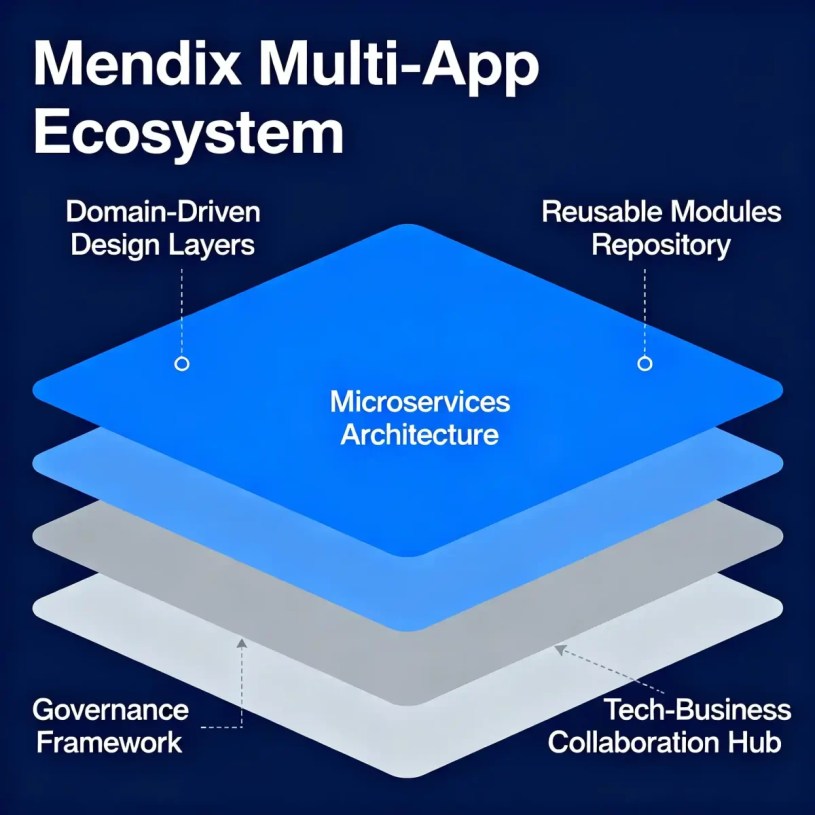
This article explores the architectural patterns essential for building and managing a thriving multi-app ecosystem in Mendix. We will delve into four foundational pillars:
- Domain-Driven Design (DDD) to create a logical and business-centric data structure.
- Reusable Modules to accelerate development and enforce consistency.
- Shared Microservices to build for flexibility and independent scalability.
- Robust Governance to maintain control, security, and quality across the portfolio.
By mastering these concepts, organizations can unlock the full potential of Mendix, transforming it from a simple app development tool into a strategic platform for enterprise-wide digital transformation.
The Foundation: Domain-Driven Design (DDD) in Mendix
Before a single page is built or a line of logic is crafted, a successful application ecosystem must be built on a solid data foundation. This is where Domain-Driven Design (DDD) comes in. At its core, DDD is a methodology tprhat aligns software development with the complex realities of the business domain. In the context of Mendix, this principle is primarily realized through the Domain Model.
For a Mendix Expert, the domain model is not just a technical diagram; it is a conceptual blueprint of the business. It visually represents the data structures, or “entities,” and the relationships between them. In a multi-app ecosystem, a well-structured domain model is the key to preventing data silos and ensuring data integrity across different applications.
The process involves breaking down large, complex business domains into smaller, more manageable ones, a practice that mirrors the database normalization seen in traditional development. For example, instead of one massive domain model for an entire retail operation, you might create separate modules for Customers, Products, Orders, and Inventory. Each module would contain its own domain model, representing its specific bounded context.
Best Practices for Domain Modeling in a Multi-App Ecosystem:
- Identify and Isolate Domains: Begin by evaluating your business processes and identifying the logical boundaries. A Customer entity might be needed in both your e-commerce app and your CRM app. DDD principles guide you to decide whether this should be a single, shared entity or two separate entities that are synchronized.
- Emphasize Clarity and Relationships: The visual nature of the Mendix domain model makes it accessible to both technical and non-technical stakeholders. Use this to your advantage. Ensure entity names and attributes use language that the business understands. Define associations clearly to represent real-world relationships, such as a Customer having multiple Orders.
- Continuous Refactoring: A domain model is not static. As business needs evolve, it must be refined. This involves analyzing entity attributes to remove redundancy, normalizing relationships to optimize data retrieval, and ensuring the model remains an accurate reflection of the business. Many developers new to the platform may not have a background in traditional database design, which can lead to inefficient models. This is where strategic Mendix Consulting becomes invaluable, helping to establish a clean, scalable data architecture from the start.
By adopting a DDD approach, you create a coherent and understandable data layer that serves as the stable foundation upon which your entire application ecosystem is built.
Accelerating Development with Reusable Modules
One of the most significant advantages of the Mendix platform is its emphasis on reusability. In a multi-app ecosystem, the ability to build, share, and reuse components is not just a convenience—it’s a core tenet of scalability and efficiency. Reinventing the wheel for every new application is a direct path to inconsistency, increased maintenance overhead, and slower delivery times.
The Mendix Marketplace is a rich repository of reusable components, ranging from small UI widgets to complete application templates. However, the true power for an enterprise lies in creating and curating its own private collection of reusable assets.
Types of Reusable Components in Mendix:
- Modules: A module is a self-contained package of functionality, often including a domain model, pages, logic (microflows), and security settings. For instance, you could build a “Single Sign-On (SSO)” module that can be dropped into any new application, instantly providing standardized authentication.
- UI Components (Widgets, Layouts, and Snippets): To ensure a consistent brand identity and user experience across your app portfolio, you can create reusable UI elements. Layouts define the overall structure of a page, snippets allow for the reuse of groups of UI elements, and custom widgets can provide unique functionality.
- Connectors and Services: In a connected ecosystem, apps constantly need to talk to other systems. Mendix allows you to build reusable connectors to external services, such as REST APIs or a variety of AWS services. Once built, this connector can be reused in any app that needs to integrate with that service.
Any proficient Mendix Development Company will prioritize the creation of a private marketplace of these components. When a new project starts, developers don’t begin from a blank slate. Instead, they assemble pre-built, pre-vetted components, allowing them to focus on delivering unique business value rather than re-implementing common features. This component-based approach drastically reduces development time and ensures that all applications adhere to company standards.
Building for Scale: Shared Microservices Architecture
As your application ecosystem grows, you will inevitably face the challenge of scalability. A monolithic architecture, where all functions are tightly coupled, struggles under heavy load and makes updates risky. This is where a microservices architecture becomes essential. This design pattern involves breaking down a large application into a collection of smaller, independent services that communicate with each other over APIs.
While Mendix is often used to build entire applications, it is also exceptionally well-suited for implementing a microservices architecture. Each Mendix application can be designed to function as a self-contained microservice, exposing its functionality and data through published REST APIs.
Benefits of a Microservices Approach in Mendix:
- Enhanced Scalability: Each microservice runs independently and can be scaled up or down based on its specific load, without affecting the rest of the ecosystem. For example, during a sales event, you can scale the Order Processing service without needing to scale the User Profile
- Increased Resilience: Because the services are independent, the failure of one service does not bring down the entire system. The other services can continue to operate, minimizing the impact on users.
- Greater Flexibility: This architecture allows you to update, replace, or even rewrite a single service without impacting the others. This accelerates development cycles and makes it easier to adapt to changing business requirements.
Implementing this pattern requires careful planning. Leading providers of Mendix Development Services excel at identifying these service boundaries by analyzing business functions and data dependencies. They then use Mendix’s native REST integration capabilities to create loosely-coupled services with well-defined interfaces. For more advanced use cases, the Mendix Data Hub provides a powerful, low-code way to unify data across the ecosystem, eliminating silos and enabling real-time insights.
Ensuring Control and Quality: The Role of Governance
As your Mendix portfolio expands to dozens or even hundreds of applications, built by various teams, the risk of chaos grows exponentially. Without a strong governance framework, you can face security vulnerabilities, inconsistent user experiences, sprawling cloud costs, and a maintenance nightmare. Low-code governance is the set of rules, roles, and processes that ensures your application landscape remains secure, compliant, and well-managed.
Mendix provides a suite of built-in tools designed to help organizations establish and enforce governance政策 across their entire portfolio.
Key Pillars of Mendix Governance:
- Centralized Portfolio Management: The Mendix platform offers a centralized view of your entire application portfolio. This allows you to manage user permissions, monitor app health, and track all development activities from a single dashboard, providing visibility into your complete Mendix landscape.
- Security and Control: Governance tools enable you to enforce security policies consistently. You can integrate with your own identity provider (BYOIdP) for user authentication, manage security risks by monitoring third-party dependencies, and ensure data is connected and governed securely.
- Curation of Reusable Components: A key part of governance is controlling quality. The platform allows you to create a curated list of vetted, approved reusable components. This ensures that developers are using high-quality, secure, and on-brand building blocks, which ties directly back to the principle of reusability. The Marketplace governance process further helps in reviewing and approving content.
- Monitoring and Optimization: To control costs and ensure performance, Mendix provides tools to monitor cloud resource usage and the operational health of your applications. This allows you to optimize deployments and prioritize digital initiatives with confidence.
Effective governance is not about restricting innovation; it’s about enabling it safely. It provides the “guardrails” that empower development teams to build quickly and autonomously, confident that they are operating within the enterprise’s standards for security, quality, and compliance.
Conclusion: Weaving It All Together
Architecting a scalable, multi-app ecosystem in Mendix is a journey that requires a holistic and strategic vision. It is the art of weaving together Domain-Driven Design, reusability, microservices, and governance into a cohesive fabric.
- Domain-Driven Design provides the logical blueprint, ensuring your applications are built on a foundation that accurately reflects your business.
- Reusable Components act as the threads, accelerating development and ensuring consistency across the entire tapestry of your ecosystem.
- Microservices Architecture gives your ecosystem the flexibility and strength to stretch and scale, adapting to changing loads and business demands.
- Governance is the frame that holds it all together, providing the structure and control needed to manage complexity and mitigate risk.
By embracing these four pillars, organizations can move beyond building individual apps and begin architecting a true enterprise-grade platform for innovation. This disciplined approach, often guided by an experienced Mendix Development Company like We LowCode transforms the Mendix platform into a powerful engine for creating resilient, scalable, and value-driven digital solutions that can evolve with your business for years to come.
 Technology & Coding Tips