
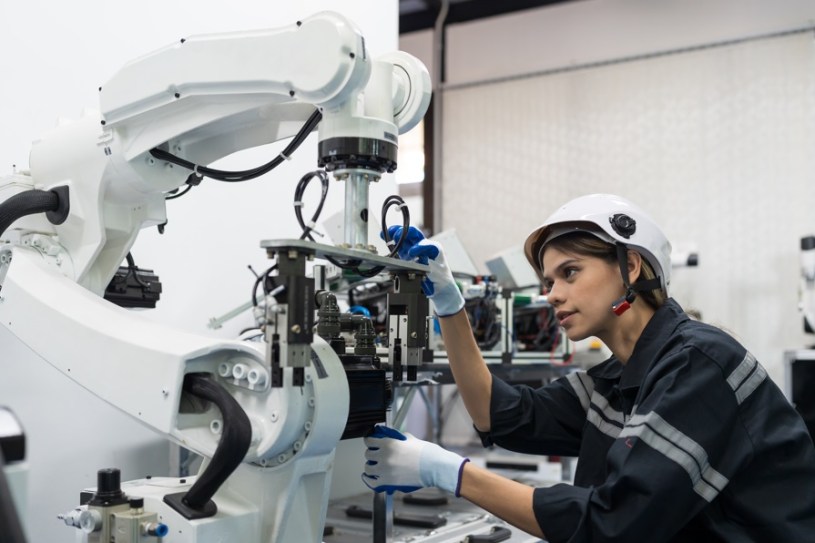
The classroom of today looks nothing like the classroom of a generation ago. Chalk-dusted blackboards have given way to interactive screens, and rote memorization has been replaced by hands-on discovery. At the heart of this transformation sits one of the most exciting forces in modern education: robotics. From primary school hallways to university labs, robotics is reshaping how students engage with science, technology, engineering, and mathematics, and the results are nothing short of remarkable.
From Theory to Tangible
One of the oldest challenges in education is the gap between abstract concepts and real-world understanding. Students can read about circuits, algorithms, or mechanical systems, but something powerful happens when they actually build them. Robotics bridges that gap in a uniquely compelling way.
When a student programs a robot to navigate a maze or picks up an object using a mechanical arm they assembled themselves, every principle becomes concrete. Physics is the reason their robot tips over when the center of gravity is off. Mathematics isn’t abstract, it’s the calculation that determines how far the robot moves with each wheel rotation. This kind of experiential learning deepens comprehension and makes knowledge stick.
Building Problem-Solvers
STEM education goes beyond teaching facts, it develops a way of thinking that fuels curiosity, problem‑solving, and innovation. Robotics is one of the most effective tools for developing critical thinking and resilience in young learners.
Robotics challenges students to define problems, design solutions, test those solutions, fail, and try again. This iterative process (often called the engineering design cycle) mirrors how professionals in technology, medicine, and engineering actually work. Students who engage regularly with robotics develop comfort with uncertainty and the confidence to tackle open-ended challenges.
Collaborative skills also flourish in robotics environments. Building and programming a robot is rarely a solo endeavor. Students must divide responsibilities, communicate clearly, and reconcile different ideas, all skills that are just as vital in the workplace as any technical knowledge.
Closing the Gap
One of the most profound contributions of robotics to STEM education is its potential to make these fields more inclusive. Historically, STEM disciplines have been less accessible to students from underserved communities, as well as to girls and young women who often receive fewer encouragements to pursue technical careers.
Robotics, when thoughtfully introduced, has shown a remarkable ability to engage students who might otherwise disengage from traditional STEM instruction. The creative, visual, and tangible nature of working with robots appeals to a broader range of learning styles. Programs that bring robotics into schools in lower-income communities have helped spark genuine interest in technology careers among students who had never previously considered them.
Integrating Robotics Across the Curriculum
A common misconception is that robotics belongs only in engineering or computer science classrooms. In reality, it integrates naturally across the curriculum.
In language arts, students write technical documentation and present project findings. In social studies, they explore the ethical implications of automation on labor markets. In art, they design aesthetically considered robots and experiment with motion as a creative medium. Even in physical education, principles of biomechanics come alive when students model human movement in their machines.
This cross-disciplinary nature makes robotics one of the rare educational tools that can unify a school’s curriculum rather than siloing it.
Preparing Students for a Rapidly Changing World
The jobs of tomorrow will demand fluency with technology in ways we are only beginning to understand. Automation, artificial intelligence, and smart systems are already transforming every sector of the economy. Students who graduate with experience in robotics enter that world with a meaningful head start.
More importantly, they enter it with the right habits of mind, curiosity, persistence, collaboration, and the ability to learn continuously. Robotics doesn’t just prepare students for specific careers; it prepares them for a lifetime of adapting to change.
The Future of Learning Is Already Here
Robotics is not a passing trend or an extracurricular novelty. It is rapidly becoming a cornerstone of forward-thinking STEM education worldwide. As educators, policymakers, and communities continue to invest in these programs, they are investing in something far greater than machines, they are investing in the next generation of thinkers, builders, and problem-solvers.
The revolution in STEM education is well underway, and robotics is leading the charge.

