
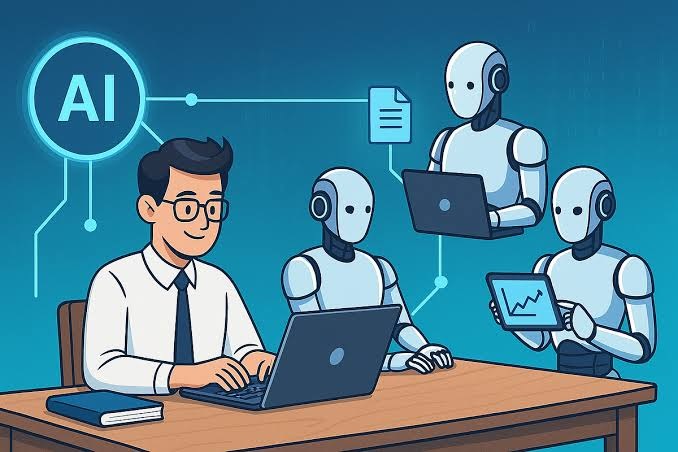
Developers do not need AI agents that behave like mystery automation. They need workflows they can inspect, pause, review, and approve. A trustworthy AI agent workflow makes the goal clear, limits permissions, records each step, and keeps humans in control of changes that affect production, customers, or source-of-truth systems.
AI coding tools have moved quickly from autocomplete to chat to agents that can investigate issues, draft changes, and carry out multi-step tasks. That power is useful, but it introduces a familiar engineering concern: if the workflow cannot be inspected, it cannot be trusted.
Start with the boundary, not the prompt
A good prompt is helpful, but the boundary around the agent matters more. Before an AI workflow runs, a team should know what systems it can access, what actions it can take, and where it must stop. The safest default is to let agents prepare work and require humans to approve actions that are hard to undo.
- Allow investigation, summaries, draft tickets, and proposed code changes.
- Gate merges, deployments, infrastructure edits, customer messages, and production data changes.
- Separate read access from write access wherever possible.
- Log the inputs, outputs, and decisions attached to each run.
This approach gives developers the benefit of agent speed without turning the agent into an unsupervised operator.
Make the workflow visible
Invisible automation creates anxiety. Developers need to see what the agent is doing, what it has completed, what it is waiting on, and where human review is required. A queue-based workflow is often easier to trust than a black-box assistant because the state of the work is explicit.
Visibility also helps teams avoid duplicate work. If one person has already asked an agent to investigate a bug or draft release notes, the rest of the team should not have to discover that by accident.
Keep review close to the work
The review step should not happen in a separate place from the agent output. The brief, generated work, comments, edits, and approval should travel together. That gives the reviewer enough context to make a decision and gives the team an audit trail if something needs to be revisited later.
For code-related tasks, this can mirror existing engineering habits: draft, diff, review, approve, merge. The agent can accelerate the draft and investigation stages, but the review discipline remains familiar.
Use agents where uncertainty is useful
Traditional automation is best for stable, repeatable steps. AI agents are more useful where the task changes each time: triaging a messy ticket, summarising logs, drafting documentation from context, or preparing a first-pass response. The workflow should reflect that uncertainty by keeping a person in the loop at the point of consequence.
This is the practical angle behind Task Force AI: AI work should become trackable, reviewable work rather than scattered output from private chat sessions. For technical teams, that difference matters because trust comes from visibility and control.
The developer-friendly pattern
A simple pattern works well: define the task, run the agent with limited permissions, capture the output, review the diff or decision, approve only what should move forward, and log the result. That is not slower than unmanaged AI. It is the structure that lets teams use AI more often with less risk.
Developers will trust AI agents when they behave like good collaborators: clear scope, visible work, reversible steps, and respect for review. The future of agent workflows depends as much on those engineering basics as it does on model capability.
 Technology & Coding Tips